

28 Jul 2026
It's 6:12 p.m. on payday. You're double-checking overtime hours for two new hires, trying to remember whether the Q2 941 deposit already went out, and an unread email from the IRS is sitting in your inbox with a subject line you don't want to open. If that sounds familiar, you haven't done anything wrong; you've simply outgrown the spreadsheet-and-good-intentions stage of running payroll.
Every growing business hits this wall. The question is never really "can we handle payroll ourselves?" Almost any business can, for a while. The real question the one that determines whether you spend the next year growing or firefighting is when to outsource payroll before a preventable mistake costs you thousands.
7 Signs You Should Outsource Payroll Right Now
Payroll outsourcing for small businesses isn't just for companies that are struggling. It's most often the businesses that are succeeding adding staff, opening locations, entering new states that hit the breaking point first. Here are the signs to watch for:
- You're spending more than 3-5 hours a week on payroll instead of on customers, sales, or hiring.
- You've hired your first employee in a new state and aren't sure which state tax registrations apply.
- You've received (or narrowly avoided) an IRS penalty notice for a late deposit or filing.
- Your entire payroll process depends on one person, and one sick day, vacation, or resignation could stall paychecks.
- You've crossed 15-20 employees and payroll has become genuinely complicated, not just time-consuming.
- You dread quarter-end and year-end tax filing season.
- A payroll mistake has already damaged trust with an employee: a missed deduction, a wrong paycheck, a late direct deposit.
If two or more of these sound like your Tuesday afternoon, that's not a coincidence; it's a pattern, and it's the clearest signal that outsourced payroll USA providers exist to solve.
In-House Payroll vs. Outsourced Payroll: What It Actually Costs
The in-house payroll vs outsourced payroll decision usually comes down to a cost comparison, but most business owners are only counting half the costs. A payroll processing services provider charges a visible, predictable fee. In-house payroll has plenty of costs that never show up on a single invoice.
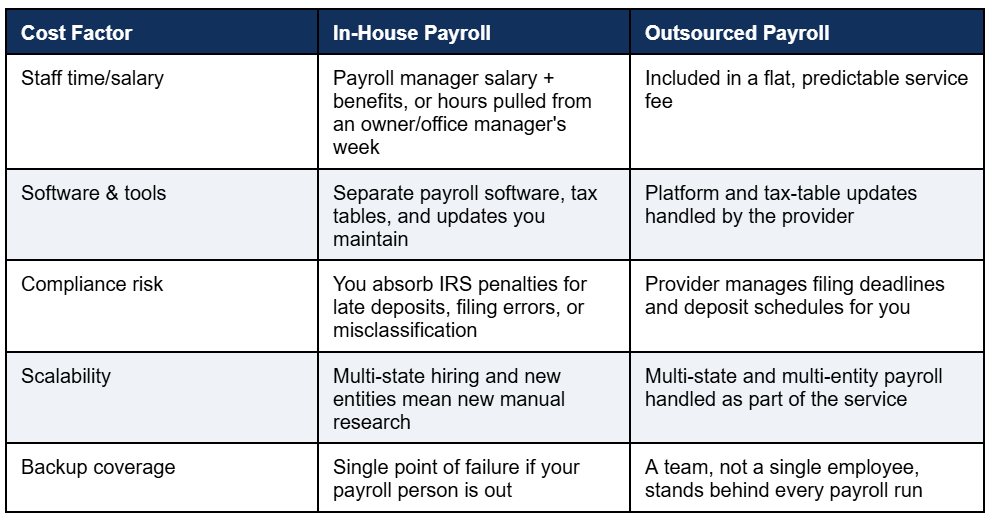
This is where payroll ROI becomes concrete. The cost of hiring a payroll manager on staff salary, payroll taxes on that salary, benefits, training, and software licenses regularly runs well beyond what a full-service payroll provider charges to manage the same workload, and that's before factoring in the cost of a single missed IRS deadline.
The Hidden Costs of In-House Payroll Nobody Talks About
- Opportunity cost: every hour spent reconciling payroll is an hour not spent on clients or growth.
- Turnover risk: if your payroll person leaves, institutional knowledge leaves with them.
- Software creep: timekeeping, direct deposit, tax filing, and reporting tools bought separately add up fast.
- Penalty exposure: the IRS doesn't discount penalties because a mistake was unintentional.
These are the hidden costs of in-house payroll, and they're exactly why more growing companies are asking why growing businesses switch to payroll outsourcing once headcount and complexity start climbing at the same time.
How Payroll Outsourcing Actually Works
Payroll processing explained simply: a full-service payroll provider collects hours and pay data (often synced directly from your time-tracking system), calculates gross-to-net pay including deductions and garnishments, files and deposits federal and state payroll taxes on your behalf, delivers direct deposits or checks on schedule, and provides reporting you can hand straight to your accountant or use for planning.
A well-run managed payroll services relationship also includes proactive payroll compliance services flagging new-hire reporting requirements, tracking state tax registrations as you expand, and keeping your filings aligned with current IRS payroll requirements so nothing slips through the cracks.
Payroll Tax Compliance: Deadlines You Can't Afford to Miss
Employer payroll responsibilities don't pause for growth; they multiply. For 2026, Form 941 (the Employer's Quarterly Federal Tax Return) is due April 30, July 31, November 2, and February 1, 2027, with the November and February dates shifted from the standard month-end because they fall on a weekend. Form 940, the annual federal unemployment return, is due February 2, 2026, for the 2025 tax year.
Deposit schedules follow a lookback period set by the IRS, and any business that accumulates $100,000 or more in payroll tax liability in a single day must deposit by the next business day, regardless of its normal schedule. Miss a deposit, and late-payment penalties start at 2% for deposits one to five days late and climb to 15% once the IRS has sent a notice. This payroll compliance checklist quarterly filings, deposit timing, new-hire reporting, and state-specific rules is precisely the workload a payroll management guide can't fully replace, but a payroll management services provider handles as a matter of course.
Built for Every Industry, Every Structure
Payroll complexity looks different by business type, and a strong payroll provider comparison should account for that. Restaurant payroll services need to handle tipped wages and variable shifts. Healthcare payroll services often involve differential pay and credentialing-linked compensation. Construction payroll services must track multi-jurisdiction job sites and prevailing wage rules. Ecommerce payroll services and retail payroll services deal with seasonal staffing swings, while professional services payroll firms need clean reporting for partner and bonus structures.
Structure matters too. Payroll for LLC and payroll for S Corporation entities each carry different owner-compensation and tax-filing nuances; reasonable-compensation rules for S Corp owners, for instance, are a common audit trigger when handled incorrectly in-house.
Is Outsourcing Right for You? Ask One Question
If your team is spending more hours managing payroll than growing the business, or if you've ever hesitated before opening a compliance email, you already have your answer.
Affordable payroll services aren't just for large enterprises. Small business payroll guides and startup-stage companies benefit just as much, often more, because a single early misstep with the IRS is harder to absorb without the cash reserves a larger company has.
Save Time, Reduce Risk, and Grow With Confidence
TaxProNext works with growing businesses across industries to replace guesswork with a full-service payroll provider relationship: accurate gross-to-net processing, on-time federal and state tax filings, multi-state support, and a compliance team that tracks deadlines so you don't have to. Whether you're a startup running payroll for the first time or an established company ready to hand off a process that's outgrown your in-house team, the goal is the same: fewer errors, lower cost, and payroll that never becomes the reason your week goes sideways.
Ready to see what outsourced payroll would look like for your business? Talk to TaxProNext about a payroll management solution built around your industry, your headcount, and your growth plans.