

15 Jul 2026
If your business only looks at its finances once a year, at tax time, you are almost certainly leaving money on the table. Tax season should be a formality, not a scramble. The businesses that consistently pay less in taxes and avoid IRS surprises are the ones that treat financial review as a habit, not an event. That habit is the quarterly financial review, and for many small businesses, it is the single most underused tool for legally reducing tax liability.
At TaxProNext, we work with business owners who assume tax planning starts in January and ends in April. In reality, the decisions that determine your tax bill happen throughout the year: how you time expenses, how you structure payroll, how you track deductions, and how accurately your books reflect what is really happening in your business. A quarterly review puts you back in control of all of it.
Why Quarterly Financial Reviews Matter
A quarterly financial review is a structured checkup of your business's financial statements, tax position, and cash flow every three months. Instead of discovering problems after the fact, you catch them while there is still time to act. This is the core idea behind year-round tax planning: taxes are not something that happens to your business in April; they are shaped by the choices you make all year long.
Quarterly reviews matter because tax law rewards proactive businesses. Deductions, retirement contributions, equipment purchases, and entity structuring decisions often need to happen before December 31 to count for the current tax year. A business that only checks its numbers annually has already missed most of its window to act.
The Hidden Cost of Waiting Until Tax Season
Many of the financial mistakes costing businesses money are not dramatic. They are small, quiet, and cumulative: an unclaimed deduction here, a misclassified expense there, an estimated tax payment that was too low. By the time a tax preparer sees your books in March, those mistakes are locked in. Although bookkeeping errors may sometimes be corrected later, many valuable planning opportunities, such as timing purchases, adjusting compensation, or making certain elections, may no longer be available after the applicable deadline
Year-end tax surprises, whether it is an unexpectedly large bill or an IRS notice about underpayment, are almost always the result of a business flying blind for eleven months and then trying to fix everything in the twelfth. A quarterly rhythm closes that gap.
What a Quarterly Financial Review Actually Covers
A proper quarterly accounting review goes beyond glancing at your bank balance. At minimum, it should include:
- A profit and loss analysis to see whether margins are trending in the right direction
- A balance sheet review to check assets, liabilities, and owner equity for accuracy
- A cash flow analysis to confirm the business can meet upcoming obligations
- A comparison of actual performance against your budget or prior-year results
- An estimated tax planning session to project your liability and adjust payments before penalties apply
This combination gives you a complete financial health check for your business, not just a tax estimate. It is also the foundation of a good business performance review, since profitability and tax efficiency are directly connected.
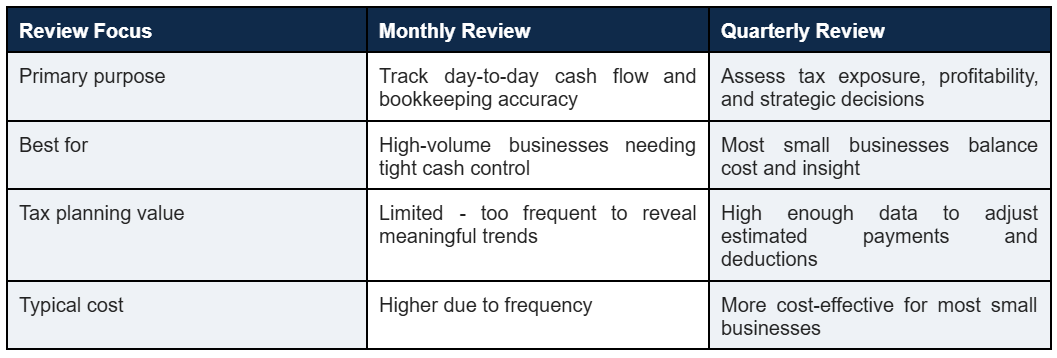
Monthly vs. Quarterly Financial Review: Which Is Right for You?
Some businesses ask whether they need monthly or quarterly reviews. The honest answer depends on complexity and cash flow volatility, but for most small businesses, quarterly reviews hit the right balance between insight and cost.
Tax-Saving Strategies Quarterly Reviews Uncover
Reducing business tax liability legally is not about aggressive loopholes. It is about consistently applying tax-saving strategies for small businesses before the deadline to use them passes. A quarterly review is where these strategies actually get identified and executed:
- Planning qualifying equipment purchases and ensuring eligible property is placed in service in time to claim available depreciation deductions.
- Reviewing business expense planning to ensure every legitimate deduction is captured
- Adjusting entity structure or owner compensation to reduce self-employment tax exposure
- Recalculating estimated tax payments each quarter to avoid IRS underpayment penalties
- Identifying retirement plan and benefits contributions that lower taxable income
These are legal tax reduction strategies available to nearly every business, but they only work if someone is watching the numbers regularly enough to act on them in time.
Staying IRS Compliant Year-Round
Business tax compliance is not just about filing on time. The IRS expects accurate estimated tax payments throughout the year, proper tax recordkeeping, and documentation that supports every deduction you claim. Businesses that only reconcile their books once a year often discover compliance gaps only after the IRS flags them.
A quarterly review builds IRS reporting requirements into your regular routine, so business tax deadlines are met with accurate numbers instead of last-minute estimates. This is especially valuable for startups and growing companies, where cash flow management for small businesses and financial planning for startups can shift quickly from one quarter to the next.
Quarterly Financial Review Checklist
Use this quarterly bookkeeping checklist as a starting point for your own review, or let TaxProNext run it for you:
- Reconcile all bank and credit card accounts
- Review the profit and loss statement against the prior quarter
- Review the balance sheet for accuracy and unexpected changes
- Run a cash flow analysis for the next 90 days
- Recalculate estimated tax payments based on year-to-date income
- Identify and document deductible expenses for the quarter
- Confirm payroll tax filings and deposits are current
- Flag any large purchases or transactions for tax treatment review
- Update financial projections for the remainder of the year
Frequently Asked Questions
How much can a quarterly financial review actually save my business?
It varies by business, but most owners who move from annual to quarterly reviews find missed deductions, correct underpaid estimated taxes before penalties accrue, and make timing decisions that add up to real savings, often in the thousands of dollars over a year.
Is a quarterly review only about taxes?
No. While tax planning for small businesses is a major benefit, a quarterly review also improves cash flow management, profitability tracking, and overall financial planning for business decisions like hiring or expansion.
Do startups need quarterly reviews, or just established businesses?
Startups benefit the most in many cases, since early financial habits shape the business for years. Startup bookkeeping and financial planning for startups set the foundation for accurate tax planning as revenue grows.
What is the difference between a bookkeeper and a quarterly financial review service?
A bookkeeper records transactions. A quarterly review goes further, analyzing what those numbers mean for your taxes, cash flow, and business decisions, which is closer to outsourced CFO advisory services than basic bookkeeping.
How do I get started with quarterly reviews?
TaxProNext offers financial review services that combine bookkeeping, tax advisory, and proactive planning into one quarterly process, so you always know where your business stands.
Make Tax Planning a Year-Round Habit
Waiting until tax season to think about taxes is one of the most expensive habits a business owner can keep. Quarterly financial reviews turn tax planning into an ongoing, proactive process instead of a once-a-year scramble, giving you the chance to legally reduce your tax bill while also strengthening cash flow, profitability, and long-term business growth planning.
| Ready to stop guessing at tax time? TaxProNext's quarterly financial review services combine bookkeeping, tax advisory, and CFO-level insight to help your business legally reduce its tax liability all year long. Schedule your free quarterly review consultation today and see exactly how much you could be saving. |