
20 Oct 2026
Before You Write Off That Business Expense
Your accounting software renews automatically. You drive your own car to a client meeting. You turn a spare room into an office. Each feels like an obvious write-off, but small business tax deductions are rarely that simple.
Paying for something through your business does not make the entire cost deductible. Under general IRS principles, deductible business expenses must be ordinary and necessary for your trade or business, subject to rules, limits, and exceptions. Treatment can depend on the expense, your business structure, your business-use percentage, your documentation, and the tax year. This guide covers federal rules; state rules may differ.
What Expenses Can a Small Business Deduct on Taxes?
Sort every cost into a category. A business expense is incurred for the business, such as advertising or a bookkeeper’s fee. A personal expense, such as groceries, is generally not deductible. A mixed-use expense serves both purposes, like a phone used for client calls and family texts, and generally requires a reasonable allocation to business use when the rules permit a deduction.
Assets are a fourth category. Equipment and other long-lasting purchases may need to be depreciated over time, or may qualify for a specific expensing election, instead of being deducted immediately.
Potentially deductible business expenses include advertising, supplies, professional services, eligible insurance, and ordinary operating costs. But usefulness alone does not decide the question. Deductibility depends on the tax rules and your facts.
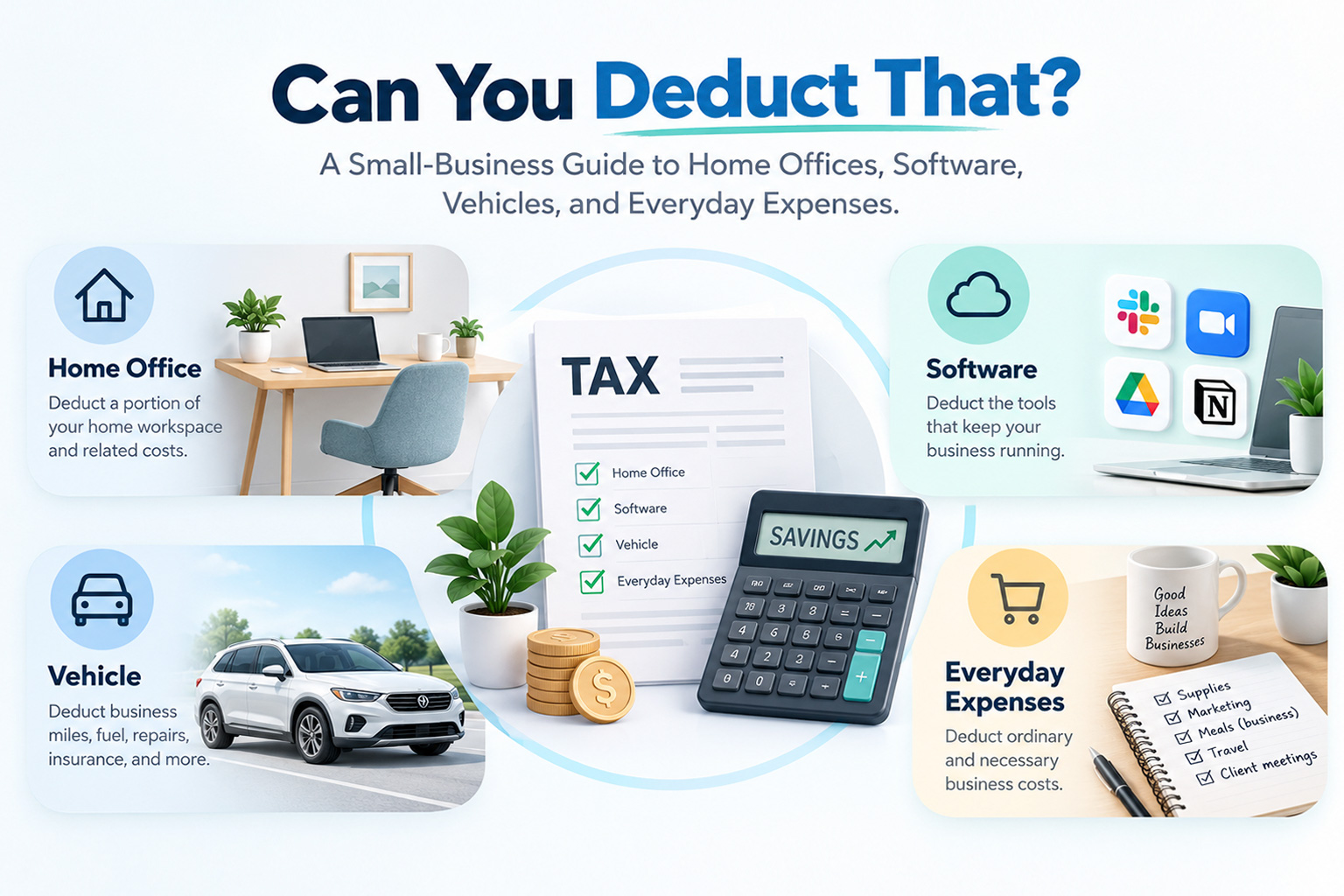
Can You Deduct Home Office Expenses?
The federal home-office deduction is for eligible self-employed taxpayers, not every remote worker. Employees generally cannot claim it for tax years after 2017, even if they work from home full time.
To qualify, part of your home generally must be used regularly and exclusively for business, and it must be your principal place of business or meet another qualifying use, such as meeting clients there in the normal course of business. Occasionally working at the kitchen table does not qualify, and a desk in a shared family room may fail the exclusive-use test. Limited exceptions exist, such as certain storage uses and daycare.
Eligible taxpayers can choose between two methods. The simplified method generally allows $5 per square foot of business space, up to 300 square feet. The actual-expense method allocates the business percentage of eligible home costs, such as rent or mortgage interest, utilities, insurance, and repairs. Either way, the deduction is subject to limits, including a gross income limitation, so keep measurements and expense records.
Are Software Subscriptions and Digital Tools Tax Deductible?
Software subscriptions and digital tools may be deductible when they are ordinary, necessary, and used for the business. Common examples include accounting and bookkeeping software, project-management tools, website hosting and business email, customer relationship management platforms, and design or productivity subscriptions used for client work.
Mixed use matters. If one design subscription serves client projects and a personal hobby, only a reasonable business portion generally qualifies. The nature of the cost matters too: a monthly subscription is typically an operating cost, while a large one-time technology purchase may call for depreciation, amortization, or an expensing election. Not every software purchase is immediately deductible, and treatment varies by business.
Can You Deduct a Personal Vehicle Used for Business?
Eligible business use of a personally owned vehicle may be deductible. Personal driving generally is not.
You generally use either the standard mileage method or the actual-expense method (gas, repairs, insurance, and depreciation), and your options depend on how you first used the vehicle for business. For 2026, the IRS business standard mileage rate is 72.5 cents per mile for miles driven January 1 through June 30 and 76 cents per mile for miles driven July 1 through December 31.
Ordinary commuting from home to a regular workplace generally is not deductible. Driving to a client site or a supplier may qualify, and special rules can apply when your home is your principal place of business. Keep a contemporaneous log of the date, destination, business purpose, and miles. If you also use the vehicle personally, only the business-use share counts. Occasional business use does not make all vehicle costs deductible, and buying a vehicle brings depreciation and expensing rules that are more complicated than gas and repairs.
Everyday Business Expenses That May Be Deductible
Depending on your circumstances, these common costs may qualify:
- Office supplies and business materials
- Advertising and marketing
- Accounting, bookkeeping, and eligible professional fees
- Business insurance
- Eligible business travel
- Business-related education that meets the requirements
- Payment-processing and business bank fees
- Eligible business phone and internet costs
- Repairs and maintenance
- Certain business meals, subject to limitations
Several of these carry specific rules. Business meals are generally limited, commonly to 50% of the cost. Travel must meet the away-from-home requirements. Education generally must maintain or improve skills for your current business rather than qualify you for a new one. Phone and internet bills need a business-use allocation. Never assume a category is automatically deductible.
What Expenses Cannot Be Deducted as Business Expenses?
Common mistakes include deducting personal, family, or living expenses unrelated to the business; ordinary commuting; entertainment, which is generally nondeductible under federal rules; political contributions and lobbying expenses where disallowed; and certain government fines and penalties. The personal portion of a mixed-use expense is also off limits.
Be precise about capital costs. A purchase that cannot be deducted immediately, such as equipment or a building improvement, is not necessarily permanently nondeductible. It may qualify for depreciation, amortization, or another form of recovery over time.
How to Keep Records and Avoid Deduction Mistakes
A few habits make deductions easier to support:
- Keep receipts, invoices, and bank or card records.
- Note the business purpose of significant expenses.
- Track business mileage separately from commuting.
- Document the business-use percentage of shared expenses.
- Separate business and personal transactions where practical.
- Review unusual purchases with a qualified tax professional.
- Retain records as long as applicable requirements say.
A receipt alone does not prove an expense is deductible. You also need the business purpose and supporting facts.
Frequently Asked Questions
What expenses can a small business deduct on taxes?
A small business can generally deduct expenses that are ordinary and necessary for its trade or business, such as advertising, supplies, professional fees, eligible insurance, and operating costs. Specific eligibility rules, limits, and documentation requirements apply, and treatment can vary by business structure.
Can I deduct home office expenses for my business?
Eligible self-employed taxpayers may deduct a home office used regularly and exclusively for business that meets a qualifying use, such as a principal place of business. The simplified method allows $5 per square foot up to 300 square feet; the actual-expense method allocates eligible home costs.
Can businesses deduct software subscriptions?
Yes, when they are ordinary, necessary, and used for the business. Personal use reduces the deduction to a reasonable business share, and large one-time or long-term technology purchases may be depreciated, amortized, or expensed under separate rules instead of treated as a simple subscription.
Can I deduct my personal vehicle used for business?
Business use of a personal vehicle may be deductible using the standard mileage or actual-expense method, when eligible. Only business miles qualify, so keep a log. Ordinary commuting between home and a regular workplace generally is not deductible.
What everyday business expenses are tax deductible?
Common examples include supplies, advertising, professional fees, business insurance, payment-processing fees, repairs, and eligible phone, internet, travel, and meal costs. Deductibility depends on business purpose, documentation, and specific limitations, such as the limit on business meals.
What expenses cannot be deducted as business expenses?
Personal expenses, ordinary commuting, generally nondeductible entertainment, and certain fines or penalties are common examples. Mixed-use costs are deductible only for their business share, and some capital costs are recovered through depreciation or amortization instead.
Make More Confident Business Tax Decisions with TaxProNext
Understanding deductions starts with accurate records, a clear line between personal and business costs, and checking the rules before you claim an expense. TaxProNext provides tax, accounting, and bookkeeping support for businesses that need help organizing financial records and understanding their tax obligations.
“Need help organizing your business expenses and preparing for tax season? Partner with TaxProNext for tax, accounting, and bookkeeping support that helps you understand your numbers and make more informed business decisions.”