
11 Nov 2026
Tax season moves faster when your records are ready before your preparer asks for them. A reliable business tax return checklist helps you report income accurately, claim deductions you can support, and answer IRS questions with confidence. It also prevents a costly mistake: missing a legitimate deduction because the receipt is gone, or filing late while you hunt for a form.
This small business tax preparation checklist covers the documents needed to file business taxes, how requirements differ by business structure, how to organize records, and how long to keep them. Not every business needs every item, so tailor it to your situation.
Documents to File vs. Records to Keep
Your preparer needs certain documents to complete the return. Separately, the IRS expects you to keep records that support what the return reports. Many items serve both purposes, but retention rules apply even to records you never hand over.
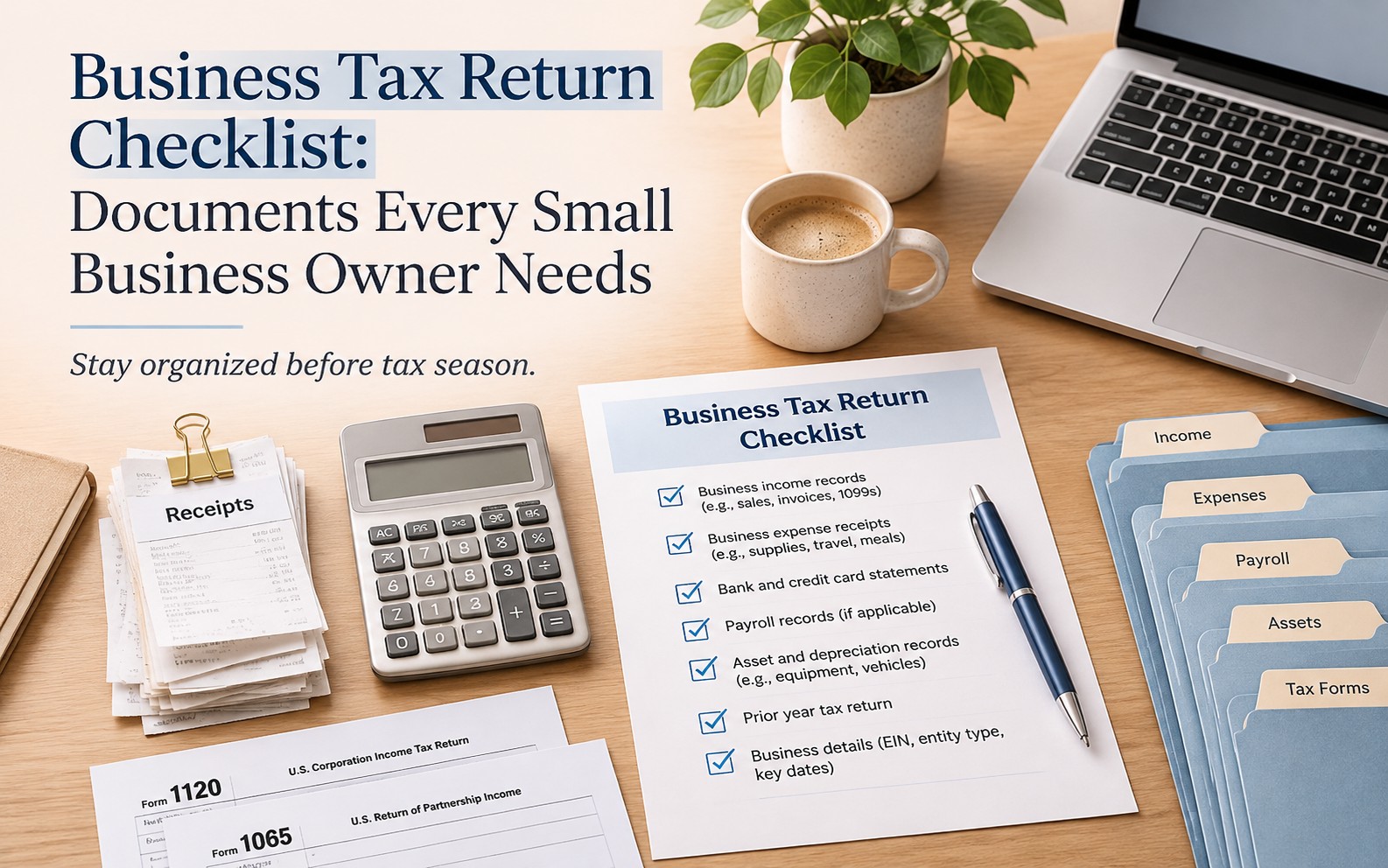
Business Tax Return Checklist
- Income records. Sales reports, deposit slips, payment-processor summaries, and any Forms 1099-NEC, 1099-MISC, or 1099-K received. Report income even if no form arrives.
- Invoices. Invoices you issued and vendor bills, showing dates, amounts, and what was sold or bought.
- Bank and credit card statements. Business account, card, and loan statements for the full year.
- Expense receipts. Receipts or paid bills showing payee, date, amount, and business purpose, plus mileage and travel logs if you deduct them.
- Payroll records. Payroll registers, Forms 941 and 940 if filed, tax deposit confirmations, and state payroll filings.
- W-2s. Copies of Forms W-2 issued to employees, and Form W-3 if you filed on paper.
- 1099s and contractor information. Forms W-9, annual payment totals, and copies of Forms 1099-NEC. For 2026 payments, the general reporting threshold is $2,000 (previously $600), with forms due February 1, 2027.
- Asset purchases. Invoices or closing statements for equipment, vehicles, or property, and the date each was placed in service.
- Depreciation. Prior depreciation schedules, Form 4562 history, and records of assets sold or retired.
- Loan interest. Lender statements or Form 1098 showing interest paid, plus loan agreements.
- Inventory. Year-end counts, your valuation method, and purchase invoices, if you sell products.
- Estimated tax payments. Dates and amounts paid, backed by IRS confirmations or bank records.
- Previous tax returns. Last year’s federal and state returns, including carryforwards.
Documents by Business Structure
Your structure determines which federal income tax return you file and which ownership records your preparer needs.
|
Structure |
Typical federal return |
Extra documents often needed |
|
Sole proprietor |
Form 1040 with Schedule C; Schedule SE |
Home office and vehicle records, if deducted |
|
Single-member LLC |
Default: Schedule C, E, or F with owner’s Form 1040 |
Same as sole proprietor, plus EIN letter and formation documents |
|
Multi-member LLC |
Default: Form 1065 and Schedule K-1s |
Operating agreement, ownership percentages, capital contributions, distributions |
|
Partnership |
Form 1065 and Schedule K-1s |
Partnership agreement, partner capital accounts, partner loans |
|
Corporation |
S corporation: Form 1120-S; C corporation: Form 1120 |
Articles of incorporation, shareholder records, officer payroll, dividends or distributions |
For calendar-year 2026 returns, partnerships and S corporations generally file by March 15, 2027. Sole proprietors and C corporations generally file by April 15, 2027.
How an LLC’s Tax Forms Depend on Classification
An LLC is a state-law entity, not a separate federal tax category. By default, the IRS treats a single-member LLC as a disregarded entity and a multi-member LLC as a partnership. An LLC can instead elect corporate treatment with Form 8832, or S corporation status with Form 2553. Confirm your classification first; the core income, expense, and payroll records stay the same.
How to Organize Business Tax Records
• Keep business and personal accounts separate.
• Reconcile your books to bank and card statements monthly.
• Create one folder per tax year, with subfolders for income, expenses, payroll, assets, and filings.
• Save digital receipts the day you receive them, noting the business purpose when it isn’t obvious.
Why Bank Statements Alone Aren’t Enough
IRS Publication 583 says supporting documents should identify the payee, amount paid, proof of payment, date incurred, and what was purchased. A statement proves money moved, not what you bought or why. Deposits create a similar gap, since they can include loans, owner contributions, or sales tax that aren’t all business income. Some expenses, such as travel and vehicle costs, carry added documentation requirements. Pair statements with receipts, invoices, and your books.
How Long to Keep Business Tax Records
The IRS says to keep records supporting income, deductions, or credits until the period of limitations for that return expires. Returns filed early are treated as filed on the due date.
• 3 years: the general rule when the situations below don’t apply.
• 3 years from filing or 2 years from payment, whichever is later: if you claim a credit or refund.
• 6 years: if you omit income exceeding 25% of the gross income shown on your return.
• 7 years: for a worthless securities loss or bad debt deduction.
• Indefinitely: if you don’t file a return or file a fraudulent one.
Keep property records until the limitations period expires for the year you dispose of the property. Employment tax records follow a separate rule: keep them at least 4 years after the tax is due or paid, whichever is later.
Frequently Asked Questions
What documents do I need to file my business tax return?
It depends on your structure and activity. Most businesses need income and expense records, statements, payroll and contractor information, asset and depreciation records, loan interest, inventory, estimated payments, and last year’s return.
What financial records should small business owners keep for taxes?
Keep books, such as journals and ledgers, that show your gross income, deductions, and credits. Back them with supporting documents: invoices, receipts, proof of payment, deposit records, payroll files, and asset records.
Do I need bank statements to file business taxes?
Statements are helpful but not always required to file. Preparers use them to reconcile income and expenses, and they help prove payment. They don’t replace receipts or invoices, which show what was purchased and why, so keep both.
What tax forms are required for small businesses?
There is no universal list. Income tax filers use Form 1040 with Schedule C, Form 1065, Form 1120-S, or Form 1120. Employers add payroll forms such as 941, 940, and W-2. Businesses paying contractors above the threshold file Form 1099-NEC.
How many years of business tax records should I keep?
Generally 3 years, but 6 years, 7 years, or indefinitely in the situations listed above. Employment tax records are a separate rule: keep them at least 4 years after the tax is due or paid, whichever is later.
Do LLCs need different documents to file business taxes?
The core records are the same, but the return and ownership paperwork depend on tax classification. A default single-member LLC reports on the owner’s Form 1040. A default multi-member LLC needs its operating agreement and capital records for Form 1065. An LLC taxed as a corporation follows corporate filing rules.
Get Your Business Tax Documents Ready With TaxProNext
TaxProNext helps small business owners stay organized and compliant. Our tax preparation services turn your documents into an accurate return; our accounting and bookkeeping support keeps records clean year-round, and our business consulting helps you plan your structure and next steps. Visit https://www.taxpronext.com to get started.