
06 Oct 2026
It’s the end of the month. Sales are coming in from a few different places, bills are piling up, and your bank feed shows a dozen transactions you can’t quite place. A tax deadline is on the calendar. One friend says you need an accountant. Another says a bookkeeper is all you need. So, which is it?
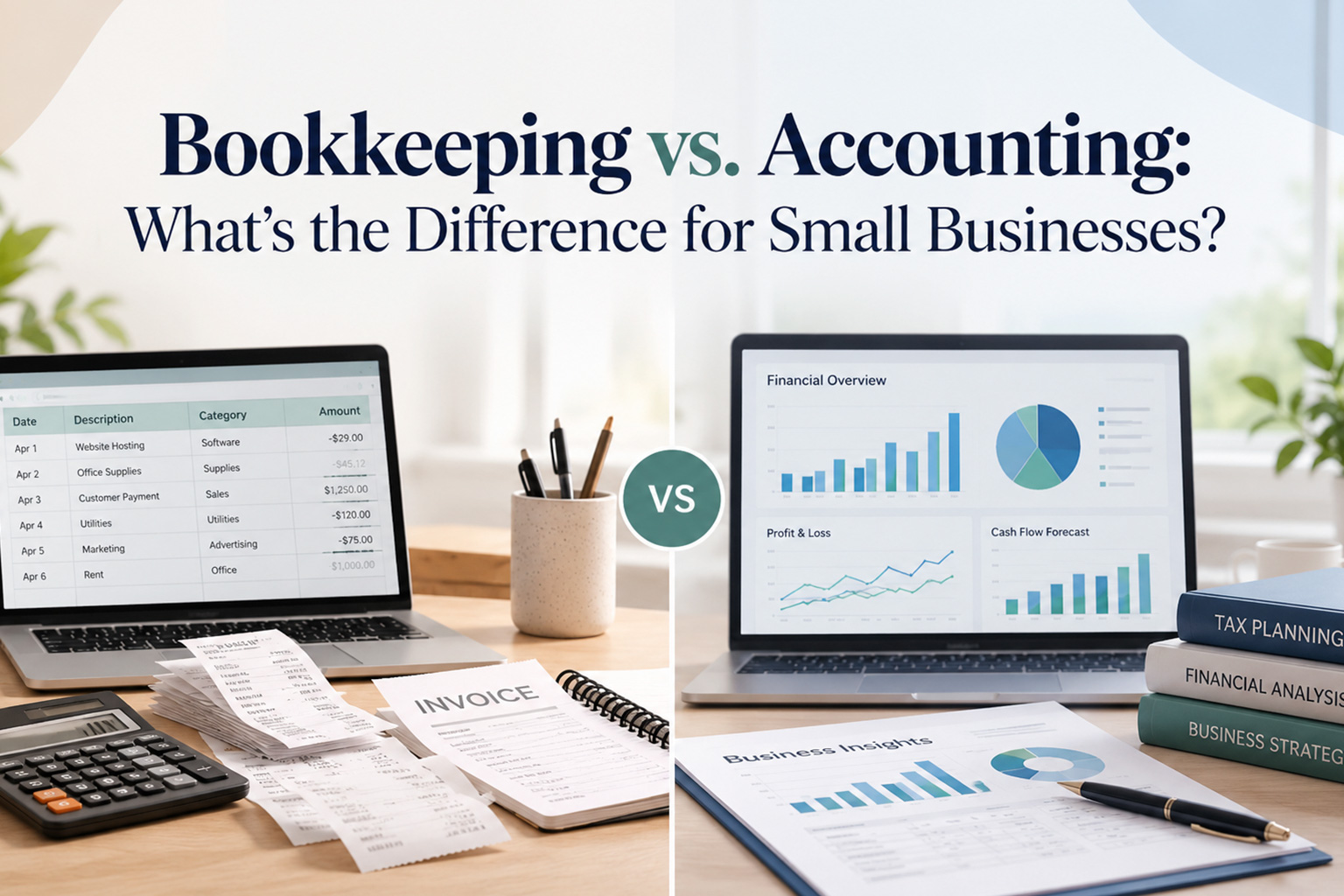
Here’s the short answer to bookkeeping vs. accounting. Bookkeeping records and organizes your financial transactions. Accounting uses that information to interpret how the business is doing and to support reporting, tax work, and decisions. The two overlap, and where one ends and the other begins depends on the professional and the business. This guide explains the difference between bookkeeping and accounting in plain terms so you can decide what your business needs.
Bookkeeping vs. Accounting: The Simple Difference
Think of bookkeeping as the daily record and accounting as what you do with it.
Bookkeeping captures what happened: sales, expenses, invoices, payments, bank transactions, and, where applicable, payroll-related records. The goal is a complete, organized, current set of books.
Accounting picks up from there. It includes preparing financial statements, reviewing performance, budgeting and planning, supporting tax-related work, and turning numbers into something an owner can act on.
One caution: these aren’t tidy legal categories. The IRS doesn’t set a universal job description for a bookkeeper or an accountant, and in real life the roles blur. Some bookkeepers produce basic reports, and some accountants enter transactions. Ask what a person actually does rather than relying on the title.
Bookkeeping vs. Accounting for Small Business
For a small business, the distinction matters because one feeds the other. An accountant, or you, can only interpret what has been recorded. Accurate bookkeeping is the foundation for everything that follows.
The IRS says good records help you prepare financial statements and tax returns, and that these are generally the same records you use to monitor the business. When books are behind, miscategorized, or missing receipts, reporting and tax preparation get harder. Somebody has to sort out the mess first, and that time costs money.
Hiring an accountant won’t automatically fix poor bookkeeping, either. Cleanup is its own job, and analysis is only as reliable as the records underneath it. Plenty of owners hope the accountant will sort things out at tax time. Sometimes that works. Often it just means a stressful tax season.
Bookkeeping vs. Accounting: What’s the Difference?
|
|
Bookkeeping |
Accounting |
|
Main purpose |
Record and organize transactions |
Interpret financial information and support decisions |
|
Typical tasks |
Categorizing income and expenses, reconciling accounts, tracking invoices and bills |
Reviewing records, preparing or analyzing statements, budgeting, tax support |
|
Focus |
What happened |
What it means and what to do next |
|
Common outputs |
Organized ledgers, reconciled accounts, basic reports |
Financial statements, analysis, planning, tax-related work |
|
When it’s needed |
Nearly always, once there’s financial activity |
Depends on size, complexity, goals, and in-house skills |
|
Level of analysis |
Low to moderate |
Moderate to high |
Treat this as a general guide. A particular professional’s scope may be narrower or wider.
What Does a Bookkeeper Do?
A bookkeeper’s work centers on keeping the books accurate and current. Depending on the business and the arrangement, that can include:
• Recording transactions from sales, expenses, and payments, often through bank and card feeds
• Categorizing income and expenses so they land in the right accounts
• Reconciling accounts by matching the books to bank and credit card statements
• Keeping receipts, invoices, and other records organized
• Tracking receivables and payables, where applicable
• Preparing basic financial information, such as simple income and expense summaries
Not every bookkeeper does all of this. Some focus on data entry, while others handle invoicing, payroll records, or month-end reconciliations. Ask for the scope in writing.
What Does an Accountant Do?
An accountant generally works with the records bookkeeping produces. Common responsibilities include:
• Reviewing financial records for accuracy and consistency
• Preparing or analyzing financial statements
• Financial reporting for owners, lenders, or other stakeholders
• Tax preparation or support, where the accountant is qualified, and it’s part of the engagement
• Planning and analysis, such as budgets and cash flow questions
• Explaining financial performance so the owner can use it
Not every accountant provides tax services. Some focus on tax, others on reporting, advisory work, or auditing, and credentials vary. Confirm what a specific professional is qualified and engaged to do.
Do Small Businesses Need Bookkeeping or Accounting?
Most businesses need accurate bookkeeping. Whether you also need accounting support depends on your size, complexity, goals, and what you can handle yourself.
The IRS states that everyone in business must keep records, and that you may choose any recordkeeping system suited to your business that clearly shows income and expenses. For a new or very small business, getting the books organized is usually the first priority.
Accounting support tends to become more valuable when:
• The business is growing
• Finances are getting more complicated
• You’re preparing to seek financing
• You’re weighing a major financial decision
• You want real financial analysis, not just recorded transactions
• Tax or reporting needs are becoming more involved
That doesn’t mean every small business must hire an accountant. Plenty run for years on careful bookkeeping and occasional outside help.
Should You Hire a Bookkeeper, Accountant, or Both?
Revenue alone doesn’t settle this. Look at what’s actually going wrong, or what you need to know.
A bookkeeper may help when:
• Transactions are increasing
• Reconciliation is eating up your time
• Your records keep falling behind
An accountant may help when:
• You need financial analysis
• You need tax preparation or support
• You don’t fully understand your financial statements
• You’re facing a major financial decision
Both may make sense when:
Your financial activity calls for steady bookkeeping and higher-level accounting work. The bookkeeper keeps the records current, and the accountant reviews and interprets them.
Can One Person Handle Both Bookkeeping and Accounting?
Sometimes, yes. It depends on business size, transaction volume, complexity, expertise, time available, and your reporting and tax needs.
In a small, simple business, the owner or one qualified person may cover both. As volume and complexity grow, splitting the work usually becomes more practical.
How Much Do Bookkeeping and Accounting Services Cost?
There’s no single price, and a flat “average” can mislead. Cost varies with transaction volume, business size, number of accounts, payroll, complexity, how often you need service, and location. It also depends on the scope of accounting or tax work and whether the arrangement is hourly, monthly, project-based, or something else.
Two businesses of similar size can pay very different amounts if one has clean books and the other needs catch-up work. Get written quotes from a few providers and compare what’s included, not just the number.
How Bookkeeping Supports Better Business Decisions
Organized records aren’t only for tax season. The IRS says good records help you monitor your business’s progress, prepare financial statements, identify sources of income, track deductible expenses, and prepare tax returns.
In practice, that means you can see where money comes from and where it goes, spot which products sell and which costs are creeping up, and hand a bank accurate statements when it asks. It also means expenses get recorded when they happen. The IRS notes that if you don’t, you may forget them when you prepare your return. That’s a good reason to update the books monthly instead of once a year.
Bookkeeping and Accounting Software
Software can take much of the manual work out of recordkeeping. Typical features include transaction recording, bank feeds and reconciliation tools, invoicing, expense tracking, and financial reports.
It helps, but it doesn’t replace judgment. A program will categorize a transaction the way it’s set up to, and it can’t tell whether that treatment fits your situation. Someone still needs to review the results.
Electronic records also have to be complete and accurate. IRS guidance says the same basic recordkeeping principles and requirements that apply to paper books and records apply to electronic ones.
Frequently Asked Questions
What is the difference between bookkeeping and accounting?
Bookkeeping records and organizes transactions, while accounting interprets that information to support reporting, tax work, and decisions. The exact split varies, so confirm scope before you hire.
Do small businesses need bookkeeping or accounting?
Most need accurate bookkeeping. Accounting support depends on the business’s size, complexity, and goals, and on what the owner can handle alone.
Is a bookkeeper the same as an accountant?
No. The roles are related and sometimes overlap, but a bookkeeper typically focuses on recording transactions and an accountant on analyzing and reporting them. Don’t assume a bookkeeper handles every accounting or tax task.
Should I hire a bookkeeper or accountant?
It depends on your problem. If records are falling behind, start with a bookkeeper. If you need analysis, tax support, or help with big decisions, look at an accountant. Many growing businesses use both.
How much do bookkeeping and accounting services cost?
It varies widely. Price depends on volume, complexity, payroll, location, scope, and billing structure, so request written quotes that spell out what’s included.
Can one person handle both bookkeeping and accounting?
In some small businesses, yes. Larger or more complex businesses usually benefit from separating the two.
The Bottom Line
Bookkeeping and accounting are related, but they do different jobs. Bookkeeping keeps your financial records organized and current. Accounting uses those records to understand the business and support financial reporting, tax work, and decision-making.
The right mix depends on your size, complexity, and needs. Start with records you can trust, then add accounting support when your questions outgrow what your books can answer.