

10 Jul 2026
Seasonal hiring is one of the fastest ways to scale a business during peak demand, think holiday retail rushes, summer hospitality surges, tax-season overflow, or harvest and construction cycles. But bringing on seasonal employees isn't just a staffing decision; it's a payroll tax decision. The IRS treats seasonal workers the same as any other employee for tax purposes, which means employers who skip a step on withholding, reporting, or classification can end up facing penalties long after the season ends.
This guide breaks down exactly what employers need to know about seasonal employee taxes.
Seasonal Employee vs. Temporary Employee: What's the Difference?
The terms are often used interchangeably, but the IRS and the Department of Labor draw a meaningful distinction. A seasonal employee works during a predictable, recurring period tied to a specific time of year, such as holiday retail or summer tourism. A temporary employee, by contrast, is hired for a short-term need that isn't necessarily tied to a season, such as covering a leave of absence or completing a short project. Both are still classified as W-2 employees in most cases, and both trigger the same core payroll tax obligations.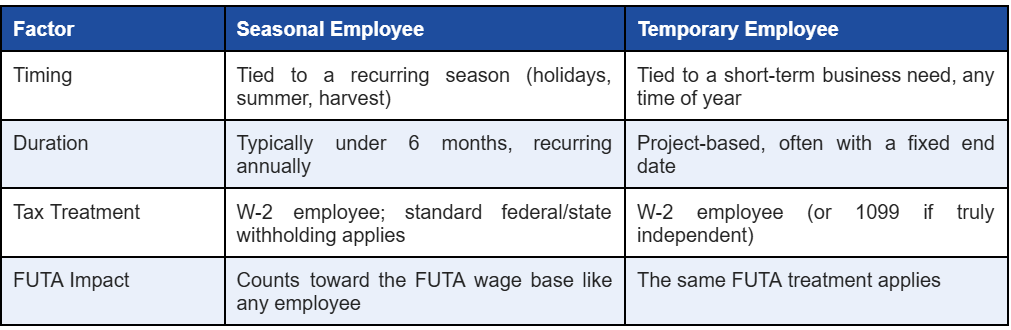
Employer Tax Obligations for Seasonal Employees
Regardless of how short the assignment is, seasonal workers trigger the same federal payroll tax requirements as any other employee. There is no seasonal exemption from employment tax law. Employers are responsible for:
* Withholding federal income tax based on the employee's Form W-4
* Withholding and matching FICA taxes (Social Security and Medicare)
* Paying Federal Unemployment Tax Act (FUTA) tax on wages up to the annual wage base
* Withholding applicable state income tax and paying state unemployment insurance (SUTA)
* Making timely payroll tax deposits based on your assigned deposit schedule
* Filing quarterly Form 941 and annual federal unemployment returns (Form 940)
One exception worth noting: full-time students working seasonally may qualify for limited exceptions in specific circumstances (such as certain school-affiliated work), but the vast majority of seasonal retail, hospitality, and administrative roles do not qualify for any special tax carve-out.
Required Forms & Reporting for Seasonal Workers
Form W-4
Every seasonal employee must complete a Form W-4 before their first paycheck. Because seasonal workers often hold multiple short-term jobs across a year, it's worth encouraging them to review the IRS withholding estimator so they aren't under-withheld across combined employers, a common source of surprise tax bills.
New Hire Reporting
Federal law requires employers to report all new hires, including seasonal and temporary employees, to their state's new hire reporting agency, typically within 20 days of the hire date (some states require faster reporting). This applies even if the employee will only work a few weeks.
Form W-2
Seasonal employees must receive a Form W-2 by January 31 of the following year, just like permanent staff, reflecting all wages paid and taxes withheld during their employment period, even if that employment lasted only a few weeks.
Payroll Tax Deposits & Filing Requirements
Adding seasonal staff can push a business into a different payroll tax deposit schedule. The IRS assigns deposit frequency (monthly or semi-weekly) based on total tax liability reported during a lookback period, and a spike in seasonal payroll can trigger a schedule change mid-year.
Missing a deposit deadline even by a day can result in penalties starting at 2% of the unpaid amount and increasing the longer the deposit is late. Employers should also confirm state-level deposit and reporting deadlines, which often run on a separate schedule from federal requirements.
Seasonal Hiring Mistakes That Lead to IRS Penalties
Peak-season hiring moves fast, and that speed is exactly where compliance gaps tend to appear. The most common mistakes employers make include:
- Misclassifying seasonal employees as independent contractors to avoid payroll tax withholding
- Delaying Form I-9 completion because the hire feels “temporary”
- Skipping new hire reporting for short-term or part-time seasonal staff
- Failing to adjust payroll tax deposit schedules after a seasonal staffing spike
- Not issuing a W-2 to employees who worked only a few weeks
- Overlooking state-specific seasonal employment or wage notice requirements
Any one of these can trigger IRS penalties, state fines, or back-tax liability, and the risk compounds when a business hires seasonally across multiple locations or states.
Seasonal Hiring by Industry
Seasonal payroll complexity varies by industry. Retail businesses ramping up for the holidays typically manage the highest volume of short-term hires and new hire reporting in a compressed window. Restaurants and hospitality employers often juggle tipped-wage compliance on top of standard seasonal withholding.
E-commerce businesses frequently hire seasonal warehouse and fulfillment staff across multiple states, multiplying state tax registration requirements. Construction and agriculture employers face their own seasonal wage and multi-state withholding rules. In every case, the underlying federal tax obligations W-4, I-9, FICA, FUTA, and W-2 apply the same way.
Seasonal Payroll Compliance Checklist
- Confirm employee classification (seasonal W-2 vs. contractor) before the first shift
- Collect Form W-4 and Form I-9 before the first paycheck is issued
- Submit the new hire report to the state agency within the required window
- Set up correct federal and state withholding in your payroll system
- Track FUTA and SUTA wage bases across all seasonal hires
- Confirm your payroll tax deposit schedule accounts for seasonal wage increases
- Issue W-2s to every seasonal employee by January 31, regardless of tenure
Frequently Asked Questions
Do seasonal employees get taxed differently than full-time employees?
No. Seasonal employees are taxed the same way as any other W-2 employee; federal income tax withholding, FICA, and applicable state taxes all apply based on their Form W-4 and wages earned.
Do I need to file a W-2 for an employee who only worked two weeks?
Yes. Any employee paid wages as a W-2 employee must receive a Form W-2 reporting those wages and withholdings, regardless of how briefly they were employed.
Can I classify seasonal workers as independent contractors instead?
Generally, no. Classification depends on the level of control an employer has over the work, not the length of the engagement. Misclassifying seasonal staff as 1099 contractors to avoid payroll taxes is one of the most commonly penalized compliance errors.
Does hiring seasonal employees affect my payroll tax deposit schedule?
It can. A significant increase in payroll liability during a season can shift a business from a monthly to a semi-weekly federal deposit schedule, so it's worth reviewing your schedule before peak hiring begins.
Seasonal Hiring Season Doesn't Have to Mean Compliance Risk
TaxProNext helps employers manage seasonal payroll, withholding, and tax filings with full compliance so you can focus on your busiest season instead of chasing deadlines. From W-4 and I-9 onboarding to payroll tax deposits and year-end W-2 filing, our team handles the details for retail, hospitality, e-commerce, and multi-state employers alike.
Talk to a TaxProNext payroll tax specialist today and hire your seasonal team with confidence.