

24 Jul 2026
It's the second week of March. Your bookkeeper just sent over a shoebox of receipts, your accountant is asking questions you can't answer, and your tax bill is bigger than you budgeted for. Sound familiar? For thousands of business owners across the U.S., this scramble isn't a one-time bad year; it's the annual routine. And it's costing them real money.
Here's the uncomfortable truth: last-minute tax filing doesn't just cause stress; it costs you deductions, triggers penalties, and leaves cash on the table that year-round tax planning could have captured.
In this guide, we break down the real difference between tax planning and tax preparation, what last-minute filing actually costs small businesses, and why proactive, quarterly tax planning is the strategy every growing business needs in 2026.
Tax Planning vs. Tax Preparation: They Are Not the Same Thing
Most business owners use these terms interchangeably. That mistake alone costs money.
- Tax preparation happens once a year, after the tax year has already ended. It's a backward-looking exercise: your accountant records what already happened and files your return. By the time preparation starts, most tax-saving opportunities have expired.
- Tax planning happens all year long. It's forward-looking: reviewing income, expenses, entity structure, and payroll decisions in real time so you can legally reduce what you owe before the year closes.
Put simply: tax preparation reports the past. Tax planning shapes the outcome. If you only ever prepare and never plan, you're always reacting, never optimizing.
The Real Cost of Last-Minute Tax Filing
Waiting until January or February to think about taxes isn't just inconvenient. It actively costs businesses money in ways that are easy to overlook:
- Missed deduction windows: Once December 31 passes, strategies like retirement contributions, equipment purchases, and income deferral are largely off the table.
- Higher audit risk: Filing in a rush increases the odds of misclassified expenses, missed 1099s, and errors that invite IRS scrutiny.
- Underpayment penalties: Businesses that don't track income throughout the year routinely underpay, triggering IRS underpayment penalties and interest.
- Cash flow shocks: Scrambling to find cash for a surprise tax bill in April disrupts payroll, inventory, and growth plans.
- No strategic advice: A rushed preparer working from incomplete books can't advise on entity structure, deductions, or credits; they're just filling out forms.
Individually, each of these seems minor. Together, they can mean thousands of dollars in avoidable tax liability every single year.
Why Year-Round Tax Planning Saves More Money
Proactive tax planning flips the script. Instead of discovering your tax bill in April, you manage it all year, and that changes everything:
- Deductions get captured in real time. Reviewing financials every quarter means deductions are identified and documented while they're still fresh, not reconstructed from memory months later.
- Decisions happen while there's still time to act. Regular check-ins let your advisor recommend the right retirement plan contributions, equipment purchases, or expense timing before deadlines pass.
- Estimated payments are accurate. Ongoing planning means your estimated tax payments reflect your actual income, not a rough guess, reducing penalty exposure.
- Entity structure is optimized as you grow. Reviewing your business structure annually (LLC, S-corp, or C-corp) can materially lower your effective tax rate as your revenue grows.
- Cash flow stays predictable. Spreading tax obligations across the year, instead of one lump sum, protects working capital and payroll.
The businesses that consistently pay the least in taxes, legally, are rarely the ones with the cleverest one-time trick. They're the ones who plan every quarter, all year long.
The IRS Doesn't Wait; Know Your Deadlines
One of the biggest advantages of year-round planning is simply staying ahead of IRS deadlines instead of being surprised by them. If your business pays estimated taxes, the typical quarterly schedule looks like this: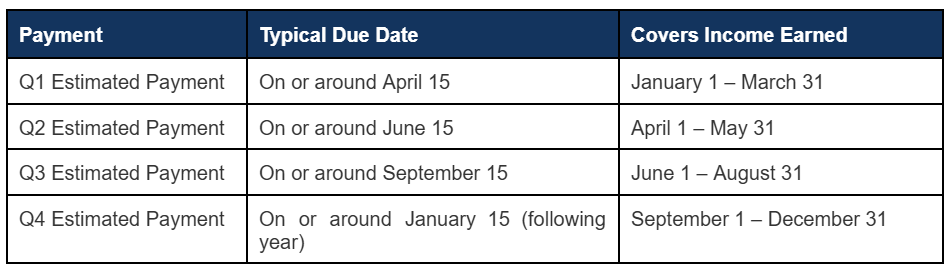
Note the pattern: the IRS divides the year into four uneven periods, not four equal quarters. Businesses that only think about taxes once a year consistently miscalculate these payments and get penalized for it. (Exact dates shift slightly when they land on a weekend or federal holiday, so always confirm the current year's schedule with your advisor or IRS.gov.)
Small Business Tax Planning Checklist
Whether you run an LLC, an S-corp, or a growing corporation, year-round tax planning generally includes:
1. Review income, expenses, and profit margins every quarter, not just at year-end.
2. Reconcile bookkeeping monthly, so your numbers are always audit-ready.
3. Calculate and pay estimated taxes each quarter based on actual, current-year performance.
4. Reassess your entity structure annually as revenue and headcount change.
5. Track deductible expenses (mileage, home office, equipment, contractor payments) as they happen.
6. Plan major purchases and payroll changes around their tax impact before you make them.
7. Hold a formal tax strategy session in Q3 or Q4 to finalize year-end moves before the window closes.
Bookkeeping Is the Foundation of Tax Planning
You can't plan around numbers you don't have. Accurate, up-to-date bookkeeping is what makes quarterly tax planning possible in the first place. Businesses that treat bookkeeping as a once-a-year cleanup exercise are, by definition, planning their taxes last-minute even if they don't realize it. Monthly financial reporting, consistent expense tracking, and clean cash flow visibility aren't back-office chores; they're the raw material every real tax-saving strategy is built on.
Stop Overpaying: Why Businesses Are Switching to Proactive Tax Planning
Every tax season, business owners ask the same question after the fact: "Could we have paid less?" Usually, the answer is yes, but by then it's too late to act on it. Year-round tax planning removes that regret. It replaces a once-a-year scramble with an ongoing partnership that catches savings opportunities as they arise, keeps you compliant with IRS filing requirements throughout the year, and gives you an accurate picture of what you'll owe long before the deadline hits.
How TaxProNext Helps Businesses Plan Smarter, Year-Round
At TaxProNext, we work with small businesses, startups, and growing corporations that are done being surprised by their tax bill. Our year-round tax advisory services combine:
- Quarterly tax planning and estimated payment calculations tailored to your actual performance.
- Ongoing bookkeeping and financial reporting that keeps your books audit-ready every month.
- Entity structure reviews to make sure you're not overpaying as your business grows.
- Dedicated CPA-led tax advisory, not just once-a-year form filing.
- Proactive IRS compliance monitoring so deadlines never catch you off guard.
The difference between a business that reacts to tax season and one that plans for it usually comes down to one decision: choosing a partner who's in your numbers every quarter, not just every April.
Ready to Stop Overpaying?
Don't wait until tax season to find out what you could have saved. Talk to TaxProNext today and build a year-round tax plan designed around your business, not around the calendar.