
21 Aug 2026
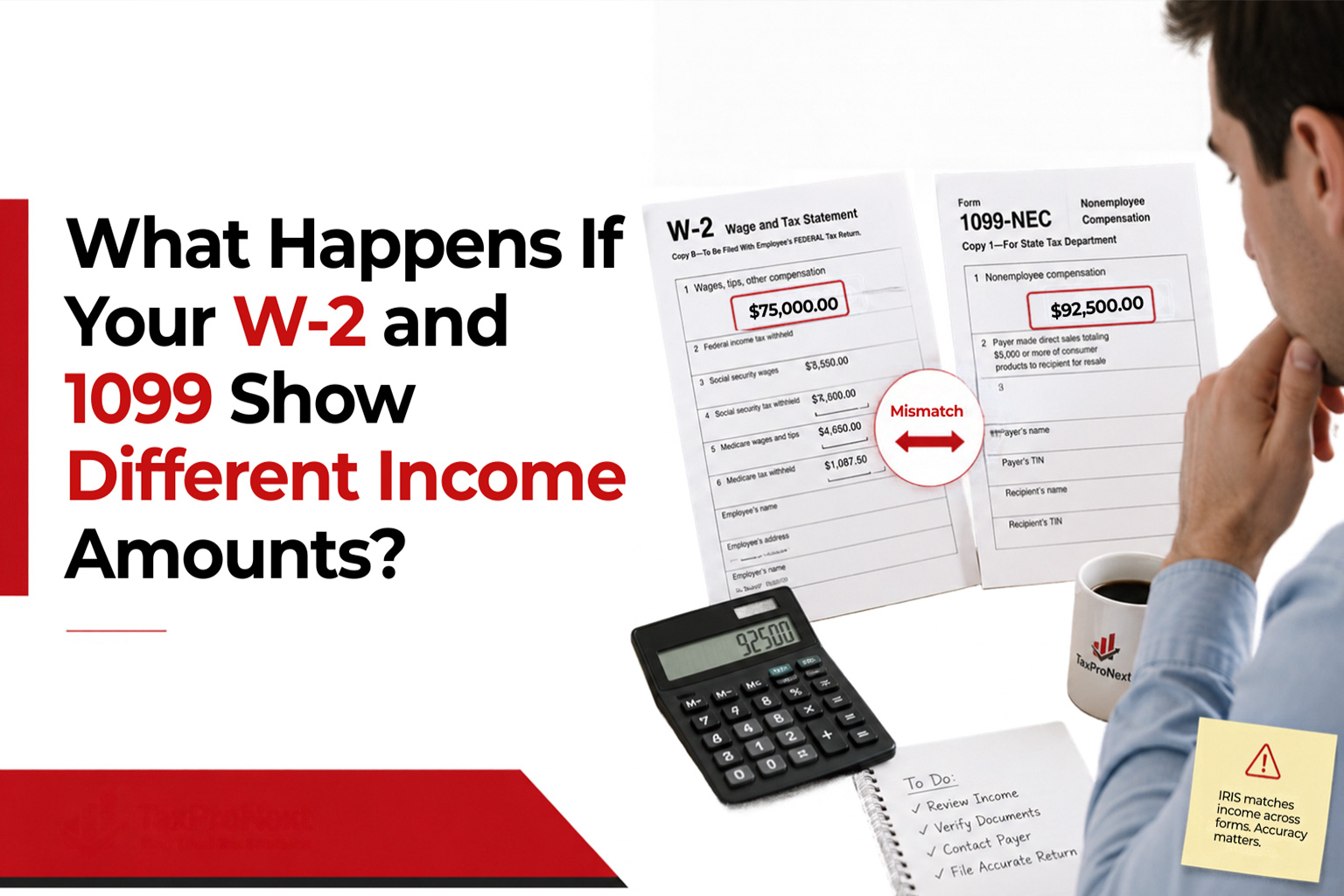
You open your mailbox in late January expecting the usual pile of tax forms. This year, though, something looks off. Your W-2 says one number. Your 1099 says another. Maybe you switched roles mid-year, picked up freelance work on the side, or your employer reclassified part of your pay. Whatever the reason, seeing two different income figures from the same employer, or even from two different sources tied to the same job, can make your stomach drop a little.
Take a breath. A mismatch between your W-2 and your 1099 is more common than most people realize, and in the vast majority of cases it is completely explainable and fixable. What matters is understanding why it happened, what the IRS actually sees on its end, and what steps you need to take before you file. That's exactly what we're going to walk through in this guide.
If you'd rather skip the research and just get it handled correctly the first time, TaxProNext works with W-2 employees, 1099 contractors, and small business owners every single day to sort out exactly this kind of confusion. But first, let's get you the full picture.
Why Would You Even Have Both a W-2 and a 1099?
Before we talk about mismatches, it helps to understand why some people receive both forms in the first place. This happens more often than you'd think, especially in industries like healthcare, real estate, construction, consulting, and the gig economy.
Common situations include:
- You worked as a W-2 employee for part of the year, then transitioned to a 1099 independent contractor role at the same company.
- You have a regular W-2 job but also do freelance or consulting work for the same employer outside your normal duties.
- Your employer classified you as an employee for some tasks and a contractor for others, a legally tricky setup known as dual status.
- You received a 1099 for something unrelated to employment, like interest income, a stock sale, or a side gig, while also holding a regular W-2 job elsewhere.
None of these situations are automatically a problem. The IRS expects that many taxpayers will have multiple income sources and multiple forms. The real question is whether the numbers on those forms are accurate and whether you're reporting all of them correctly.
So Why Do the Numbers on My W-2 and 1099 Not Match?
A W-2 and a 1099 aren't just two versions of the same document; they report fundamentally different things, calculated in different ways. Here are the most common reasons your figures don't line up.
1. They're reporting different types of pay
Your W-2 reports wages, salary, tips, and taxable benefits, minus things like pre-tax retirement contributions and pre-tax health insurance premiums. A 1099-NEC or 1099-MISC reports gross payments made to you as a non-employee, with no deductions taken out at all. If you're comparing gross contractor pay to net employee wages, of course the numbers will look different.
2. Timing differences
W-2 wages are reported based on when you were paid, not when you earned them. A paycheck issued in the first few days of January for work done in late December often lands on the following year's W-2. 1099 income can follow slightly different timing rules depending on the payer's accounting method, which can create small gaps between what you expected and what shows up.
3. Reimbursed expenses got bundled into the 1099
If a company reimburses a contractor for mileage, supplies, or travel and simply adds that reimbursement into the total on the 1099-NEC instead of handling it separately, the form will show more income than the contractor actually earned in fees.
4. Worker misclassification
This is the one that deserves the most attention. Sometimes an employer issues a 1099 for work that, legally, should have been reported on a W-2, or vice versa. This can happen by accident, or it can happen because a business is trying to avoid payroll taxes. Either way, it creates a real discrepancy that the IRS cares about, and it's a pattern our team sees flagged in IRS notices more often than people expect.
5. Simple payroll or bookkeeping errors
Sometimes it really is just a mistake. A decimal point in the wrong place, a duplicate payment recorded twice, or a bonus that got coded incorrectly can all throw off the totals on either form.
Can You Legally Have a W-2 and a 1099 From the Same Company?
Yes, but it has to be handled carefully. The IRS does allow a worker to receive both a W-2 and a 1099 from the same employer in the same tax year, as long as the work reflected on each form is genuinely different in nature. For example, a full-time W-2 employee who also does unrelated freelance design work for the same company on weekends could legitimately receive a 1099 for that separate project.
What the IRS does not allow is using a 1099 to describe work that meets the legal definition of employment simply to save on payroll taxes. The IRS uses a behavioral, financial, and relationship-based test to determine whether someone is truly an independent contractor or an employee, regardless of what the paperwork says. If the work, hours, tools, and level of control all point to an employer-employee relationship, calling it a 1099 arrangement doesn't change the underlying reality, and it can create liability for the business and confusion for the worker.
What Happens If You Just Report the Numbers and Move On?
This is where things get serious, and it's the part most people skip past. The IRS receives a copy of every W-2 and every 1099 issued in your name, matched to your Social Security number, through its automated Information Returns matching program. When the totals on your tax return don't line up with what the IRS already has on file, it doesn't just get quietly ignored.
Depending on the size and nature of the discrepancy, you could see:
- A CP2000 notice, which is the IRS's automated way of flagging a mismatch between what was reported to them and what you filed.
- A delay in processing your return or your refund while the discrepancy is reviewed.
- Additional tax owed, plus interest, if income was underreported.
- Penalties for underpayment, and in more serious cases, for failure to pay self-employment tax on 1099 income.
- A closer look at your worker classification if the pattern suggests misclassification, which can affect the business that paid you as well.
The good news is that almost none of this is unavoidable. It's a process issue, not a character issue. The fix is almost always about reconciling the numbers correctly before you file, not fighting the IRS after the fact.
How to Fix a W-2 and 1099 Discrepancy the Right Way
If you've noticed a mismatch, here's the approach a tax professional will typically take, and one you can start thinking through yourself.
- Line up every form side by side and separate gross pay, reimbursements, deductions, and taxable benefits, so you're comparing apples to apples.
- Confirm your worker classification for each form. Ask whether the work reported on the 1099 was genuinely separate from your W-2 duties.
- Request a corrected form. If a payer made an error, they can issue a corrected W-2c or a corrected 1099 before you file.
- Report both forms fully and accurately, including the self-employment tax owed on 1099 income, even if the numbers feel inconsistent with each other.
- Keep documentation. Pay stubs, contracts, invoices, and correspondence with your employer all help support your numbers if a question ever comes up later.
- If you believe you were misclassified, you may be able to file Form 8919 to report your share of Social Security and Medicare tax without paying the full self-employment rate, but this needs to be evaluated carefully with a professional, since it can trigger further review of the employer.
A Quick Real-World Example
One client came to TaxProNext after switching from a staff role to a contract role at the same healthcare group midway through the year. Her W-2 showed roughly nine months of salary. Her 1099 showed three months of contract fees, but the total looked much higher than expected because her employer had rolled a mileage reimbursement and a signing bonus into the 1099 total instead of separating them. Once we broke the form down line by line, matched it against her contract, and confirmed the reimbursement portion, her actual taxable contract income was several thousand dollars lower than the form implied. We helped her request a corrected 1099 and filed her return with accurate, defensible numbers, avoiding an overpayment and a future notice.
This is a common story. The number on the form isn't always the number you actually owe tax on, and knowing the difference is where a lot of value gets created for our clients.
Why This Is Worth Getting Professional Help With
W-2 and 1099 discrepancies sit right at the intersection of payroll rules, self-employment tax, worker classification law, and IRS matching systems. Sorting through it correctly means understanding all four at once, and getting it wrong in either direction can cost you: overpaying because you didn't separate reimbursements from income, or underpaying because a classification issue went unnoticed until a notice showed up in your mailbox.
This is exactly the kind of situation TaxProNext handles for individuals, dual-status workers, and small business owners across the country. Our team reviews every form line by line, checks it against your actual pay history, corrects errors with payers when needed, and files a return that reflects what you truly earned, not just what a form happens to say. If you're also the one issuing W-2s and 1099s to your team, we can help you review your worker classifications on the front end so this never becomes a problem in the first place.
Whether you're dealing with a one-time mismatch this filing season or you regularly juggle W-2 and 1099 income as part of how you work, having an experienced tax advisor look at the full picture before you file is the simplest way to protect your refund and stay off the IRS's radar.
Frequently Asked Questions
What happens if my W-2 and 1099 show different income amounts?
In most cases, this is expected because a W-2 reports net taxable wages while a 1099 reports gross non-employee payments. The key is confirming the difference is explainable through deductions, reimbursements, or timing, and reporting both forms accurately on your return.
Can you have a W-2 and 1099 from the same company in the same year?
Yes, as long as the W-2 work and the 1099 work are genuinely different roles or projects. If both forms describe the same type of work under the same conditions, it may point to worker misclassification, which should be reviewed.
Will the IRS notice if my W-2 and 1099 don't match what I report?
Yes. The IRS automatically matches every W-2 and 1099 issued under your Social Security number against your tax return. A mismatch can trigger a CP2000 notice, processing delays, or additional tax and penalties.
How do I fix a W-2 or 1099 that has an error on it?
Contact the employer or payer and request a corrected form, a W-2c for wages or a corrected 1099 for contract income. Keep pay stubs, contracts, and invoices as backup documentation in case questions come up later.
Do I have to report both my W-2 and 1099 income?
Yes. All income needs to be reported, regardless of which form it came on. W-2 income is taxed through payroll withholding, while 1099 income is subject to self-employment tax in addition to income tax.
Get Your W-2 and 1099 Reconciled the Right Way
Mismatched tax forms are stressful, but they're rarely as bad as they first appear. What you need is someone who can look at your actual pay history, your contracts, and your forms side by side and tell you exactly what's owed and why.
TaxProNext helps W-2 employees, 1099 contractors, dual-status workers, and small business owners across the U.S. get their tax filings right the first time. Reach out to our team today for a review of your income documents before you file, and file this season with confidence instead of guesswork.