
10 Nov 2026
|
QUICK ANSWER By default, a single-member LLC is a disregarded entity taxed on the owner's Form 1040, usually Schedule C. A multi-member LLC is taxed as a partnership, filing Form 1065 and issuing Schedule K-1s. Either can elect corporate or S corporation treatment. |
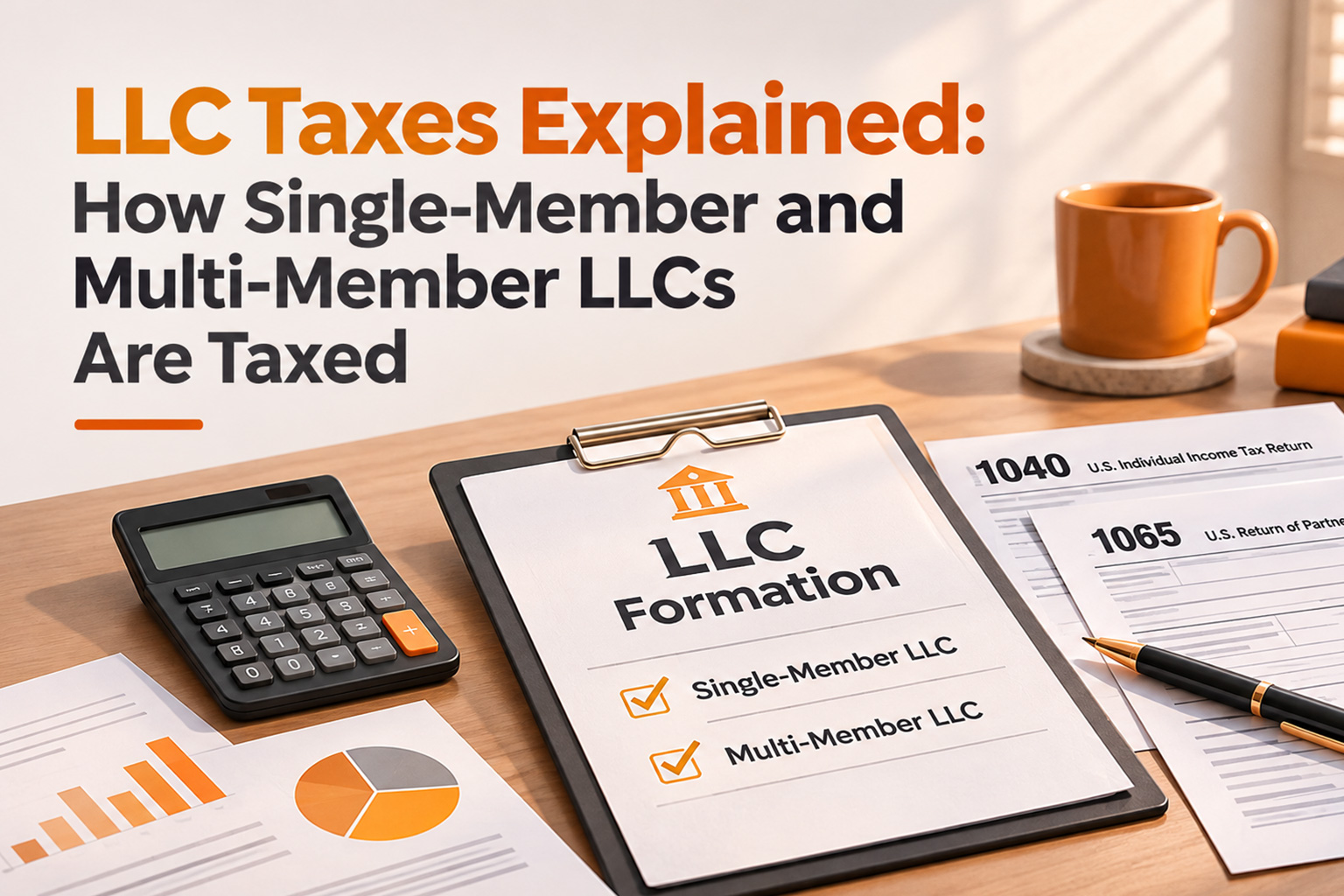
An LLC is a legal business structure created under state law, not a federal tax classification. How the IRS taxes your LLC depends on how many owners (members) it has and whether it has made a tax election. Knowing which rules apply helps you file the right forms and avoid surprises.
This guide explains how single-member LLC taxes and multi-member LLC taxes work by default, what an S corporation election changes, and what to do in practice.
How Single-Member LLC Taxes Work
By default, the IRS treats a single-member LLC as a “disregarded entity,” meaning it is disregarded as separate from its owner for federal income tax purposes. The LLC keeps its state-law liability protection but does not file its own federal income tax return.
Reporting income on Schedule C
An individual owner generally reports the LLC's income and expenses on Schedule C (Form 1040), and net profit is taxed at the owner's individual rates whether or not it is withdrawn. If the owner is a corporation or partnership, the activity appears on that owner's return instead.
Self-employment tax
The IRS notes that an individual owner of a disregarded LLC is not an employee of it. Owners therefore generally pay self-employment tax on net earnings of $400 or more: 15.3% (12.4% Social Security plus 2.9% Medicare) on 92.35% of net earnings, with the Social Security portion capped at an annual wage base. Half of the tax is deductible.
How Multi-Member LLC Taxes Work
An LLC with two or more members is classified as a partnership by default. It files Form 1065, U.S. Return of Partnership Income, reporting income, deductions, and credits. For calendar-year LLCs, it is generally due March 15 (the next business day if that falls on a weekend or holiday), and Form 7004 requests an automatic six-month extension.
Schedule K-1 and profit allocation
The LLC issues each member a Schedule K-1 showing that member's share of income, losses, deductions, and credits. Allocations usually follow the operating agreement and must be consistent with tax rules, so a clear written agreement matters.
Each member's tax responsibility
Members report their K-1 amounts on their own returns and owe tax on their share, even if the LLC kept the cash. Members are generally not employees, so active members may owe self-employment tax on their share of business income and guaranteed payments, depending on each member's role and the facts.
Do LLCs Pay Federal Income Tax?
Under the default rules, not at the entity level. Neither a disregarded LLC nor a partnership-classified LLC pays federal income tax itself; the owners pay on their individual returns. An LLC that elects corporate treatment with Form 8832 is different: it files its own corporate return and pays corporate income tax.
“No entity-level income tax” does not mean “no taxes.” An LLC may still owe employment taxes (a disregarded LLC is treated as a separate entity for employment tax and certain excise taxes), state income or franchise taxes, annual state LLC fees, and sales tax. Requirements differ by state.
Can an LLC Choose S Corporation Tax Treatment?
Yes, if it qualifies. An LLC is not an S corporation by default; it elects S corporation tax treatment by filing Form 2553, Election by a Small Business Corporation. An eligible LLC that files a timely Form 2553 is generally treated as also electing corporate classification, so Form 8832 is not required.
Eligibility and deadline
• Domestic entity with no more than 100 shareholders
• Only eligible shareholders, generally individuals, estates, and certain trusts (not partnerships or corporations)
• No nonresident alien shareholders
• Only one class of stock
• Consent from every shareholder
File no later than two months and 15 days after the start of the tax year the election takes effect, or any time during the preceding tax year. For a calendar-year LLC, an election for 2027 can be filed during 2026 or by March 15, 2027. Late-election relief may be available for reasonable cause.
Reasonable compensation and payroll
Owners who work in the business are treated as employees. The company must pay them reasonable compensation through payroll, with withholding and deposits, before non-wage distributions. The IRS can recharacterize distributions as wages if pay is too low. The company also files Form 1120-S and issues K-1s.
Potential tax implications
Profit beyond reasonable wages passes through to owners and is generally not subject to self-employment tax. But payroll costs, added compliance, and differing state treatment can offset that. S corporation status does not automatically reduce taxes; results depend on profit, owner pay, and location.
Single-Member vs. Multi-Member LLC Taxes: Side-by-Side
|
Topic |
Single-member LLC |
Multi-member LLC |
|
Default classification |
Disregarded entity |
Partnership |
|
Main federal forms |
Form 1040 with Schedule C and Schedule SE |
Form 1065, Schedule K-1 for each member, and members' Form 1040 |
|
Entity-level income tax |
None by default |
None by default |
|
Income reporting |
Owner reports all net income |
Each member reports an allocated share |
|
Self-employment tax |
Generally on the owner's net earnings |
Generally on active members' share and guaranteed payments, depending on facts |
Practical LLC Tax Considerations
Estimated tax payments
Nobody withholds tax from LLC profits, so owners and members generally pay estimated taxes quarterly with Form 1040-ES, covering income and self-employment tax. Payments are generally due April 15, June 15, September 15, and January 15, adjusted for weekends and holidays.
Deductible expenses and recordkeeping
Ordinary and necessary business expenses, such as software, advertising, professional fees, and supplies, can reduce taxable profit. Keep a separate business bank account, save receipts and invoices, and track mileage. Records are generally kept at least three years, longer in some situations. Multi-member LLCs should also retain the operating agreement.
State-specific taxes
Some states charge annual LLC fees, franchise taxes, or gross-receipts taxes regardless of profit.
When professional guidance helps
Consider expert help when adding or removing a member, weighing an S corporation election, hiring employees, or working across states.
LLC Taxes: Frequently Asked Questions
How is a single-member LLC taxed?
By default, as a disregarded entity. Profit or loss is reported on the owner's individual return, usually Schedule C, and the owner generally pays income tax plus self-employment tax. The LLC can elect corporate or S corporation treatment instead.
How is a multi-member LLC taxed?
By default, as a partnership. The LLC files Form 1065 and issues Schedule K-1s, and each member reports their share of income on their own return.
Do LLCs pay federal income tax?
Not by default. Income passes through to the owners, who pay tax individually. An LLC that elects corporate treatment pays corporate income tax itself, and employment, excise, and state taxes may still apply.
Does a single-member LLC file a separate tax return?
Generally not for federal income tax; the owner reports everything on Form 1040. The LLC may still file employment or excise tax returns under its own EIN, and one that elects corporate treatment files its own return.
How do multi-member LLCs file taxes?
They file Form 1065 by the 15th day of the third month after year-end (March 15 for calendar-year LLCs) and furnish each member a Schedule K-1. Members report those amounts on their individual returns.
What is the difference between single-member and multi-member LLC taxes?
The number of owners sets the default classification. A single owner reports on Form 1040; multiple owners form a partnership that files an information return and allocates income through K-1s.
Can an LLC choose to be taxed as an S corporation?
Yes, if it meets the eligibility requirements and files Form 2553 on time. It must also pay owner-employees reasonable compensation through payroll. Whether it helps depends on your circumstances.
|
Get Clear Answers on Your LLC Taxes How your LLC is taxed affects your forms, deadlines, and cash flow. TaxProNext supports U.S. entrepreneurs with tax preparation, business setup, accounting and bookkeeping, and business consulting. Whether you are forming an LLC, adding a member, or weighing an S election, our team can review your situation and walk through your options before you file. |